FIE or OÜ for Beauty Professionals in Estonia: Which to Choose?
Short answer: An FIE is usually lighter to administer, but the beauty professional remains personally liable and normally faces quarterly social-tax advances. An OÜ separates the company's obligations from the shareholder, supports reinvestment and a growing salon, but requires double-entry accounting and an annual report. Neither form is automatically cheaper: compare liability, real expenses, cash withdrawals and how independently you work.
This guide reflects the official rules available on 13 July 2026. It provides general information, not individual tax or legal advice. Before registering, give an accountant your expected revenue, documented costs, other employment, contracts and the amount you need to take home. Those facts matter more than a generic online verdict.
FIE vs OÜ at a glance
| Question | FIE (sole proprietor) | OÜ (private limited company) |
|---|---|---|
| Who runs the business? | The individual trades in their own name | A separate legal person provides the service |
| Liability | The FIE is liable with all personal assets | The OÜ answers with company assets; its shareholder is generally not personally liable |
| Online establishment | No capital requirement; €20 state fee | Capital can start at €0.01; €265 state fee |
| Bookkeeping | Cash-basis accounting is allowed; no annual report | Double-entry bookkeeping and an annual report |
| Income-tax logic | Business income after permitted costs and the social-tax adjustment is taxed as personal income | Corporate tax generally arises when profit is distributed and on specified taxable expenses |
| Social tax | Usually quarterly advances followed by an annual calculation | Depends on the actual payments made to an owner who works in the company |
| VAT threshold | Same €40,000 threshold logic | Same €40,000 threshold logic |
The table is a map, not a recommendation. A lash artist testing demand from a shared room and a salon signing a long lease, employing a team and financing equipment may reach different answers even with similar first-year revenue.
Liability is the first decision, not a footnote
An FIE is not a legal entity separate from the individual. The official e-Business Register comparison states that a sole trader is responsible for business liabilities with all assets. An unpaid studio lease, supplier debt or valid damages claim therefore does not stay inside a separate company balance sheet.
An OÜ is a separate legal person. Under section 135 of the Commercial Code, a shareholder is not personally liable for the OÜ's obligations; the company is liable with its own assets. This is limited liability, not immunity. A personal guarantee remains personal, and a management-board member can be liable for damage caused by breaching their duties. Insurance, safe procedures and careful contracts still matter.
For a beauty professional, exposure tends to grow with a multi-year lease, financed devices, employees and services that can cause a meaningful client claim. An OÜ creates a clearer boundary for ordinary company obligations. It does not rescue a careless guarantee or make an unsafe treatment safe.
Registration costs and practical startup capital
The e-Business Register currently lists a €20 state fee for an FIE, with no capital or articles of association. An FIE can also register temporary or seasonal operation. Establishing an OÜ online carries a €265 state fee, requires articles and a management board, and can use share capital as low as €0.01 where the smallest share of one shareholder is one cent.
The one-cent figure is a legal minimum, not a sensible salon budget. A deposit, initial stock, hygiene supplies, equipment maintenance, liability cover and a quiet-month reserve need actual cash regardless of the form. Compare both establishment fees, but also price the commitments you will sign after registration.
Opening premises brings a different compliance track. Our guide to opening a beauty salon in Estonia covers premises, health certificates and proof of professional skills. Registering as an FIE or OÜ does not replace those duties.
FIE bookkeeping: lighter does not mean record-free
Section 43 of the Accounting Act allows an FIE to keep cash-basis accounts and exempts the proprietor from an annual report. In broad terms, income is recorded when received and an expense when paid. This can make a small practice easier to administer.
The FIE still needs source documents and a clear record of business income and expenses. Personal spending does not become deductible because it passed through the same card, and a business purchase needs evidence and a business purpose. Form E accompanies the individual's annual income-tax return. A separate working account and a monthly reconciliation are useful even where a dedicated business bank account is not the legal issue.
Cash-basis accounting also does not answer every tax question. Mixed-use premises, training, travel, devices used privately and costs shared with another professional may need allocation. Ask about the facts before assuming that a receipt guarantees a deduction.
OÜ accounting and the annual report
An OÜ is an accounting entity that uses double-entry bookkeeping. Company money must remain distinct from the shareholder's personal money, and every transaction needs the correct accounting treatment. The management board prepares an annual report; section 179 of the Commercial Code requires the approved report to be filed with the register within six months after the financial year ends.
A very small or dormant OÜ does not simply lose that duty because it issued few invoices. Decide who collects purchase invoices, records cash, checks bank transactions, classifies payments to the owner and files any recurring tax returns. Accountant fees are not the only factor in the choice, but they are a real recurring cost and require timely input from the owner.
How an FIE is taxed in 2026
An FIE is not taxed on every euro of turnover without regard to costs. Documented expenses connected with the business can generally reduce business income under the applicable rules. The EMTA guide to income tax for self-employed persons gives a 22% income-tax rate for 2026. The final calculation uses the social-tax-adjusted business income on Form E together with the individual's Form A income and permitted deductions.
The cash-flow feature that surprises many new FIEs is the social-tax advance. According to EMTA's 2026 advance-payment guidance, the monthly base is €886, the social-tax rate is 33%, and a full quarter's advance is €877.14. The 2026 deadlines are 16 March, 15 June, 15 September and 15 December.
That amount is an advance, not necessarily every person's final quarterly tax. It may be reduced or not due when sufficient social tax is paid by an employer or the state, or when a qualifying exception applies, including certain pension, study or work-ability situations. Starting, ending or suspending the FIE during a quarter can also change the calculation. EMTA makes the final annual assessment from the tax return.
The useful planning question for a seasonal beauty practice is therefore not only “what is my estimated annual tax?” but also “what must be available on each quarterly date after a quiet month?” Do not budget either zero or €877.14 without checking your own e-MTA position.
How an OÜ is taxed when money stays in or leaves the company
An Estonian OÜ does not pay ordinary corporate income tax merely because operating profit arose. EMTA explains that corporate income tax is charged when profit is distributed, as well as on non-business expenditure, fringe benefits, gifts, donations and specified other items. Distributed profit is taxed at company level at 22/78 in 2026. The former reduced rate for regularly paid dividends was abolished from 2025, as shown in EMTA's current tax-rate table.
Deferral can be valuable when profit remains in the OÜ for a treatment device, fit-out, marketing, a new chair or a liquidity reserve. It does not make the company bank balance tax-free personal spending. Salary, management-board remuneration, a documented expense reimbursement and a dividend are different payments with different legal and tax bases.
This distinction is especially important for an owner who actively serves clients or runs the salon. Dividends compensate ownership; they cannot simply replace remuneration for actual work. EMTA's guidance on labour-tax payments says active duties must be remunerated according to their substance. It does not impose one universal salary number: the real contribution, sector, region and company's condition all matter.
That is why “an OÜ always pays less tax” is not a sound conclusion. The result changes with reinvestment, personal cash needs, the owner's work, deductible costs and accounting fees. If the separate question is how a salon should pay an employee or contract with an independent stylist, see our guide to paying a stylist in Estonia. This article deliberately does not repeat its commission percentages or worked payroll example.
The €40,000 VAT threshold does not favour either form
Choosing an OÜ instead of an FIE does not change the standard VAT-registration test. EMTA states that registration becomes compulsory when the relevant supply whose place of supply is Estonia exceeds €40,000 from the start of the calendar year. The official VAT-registration page also explains that voluntary registration may be possible below the threshold.
Monitor qualifying turnover, not just the bank balance. Advance payments, gift cards, product sales, timing rules and cross-border purchases can require separate analysis. For a consumer-facing beauty business, the pricing effect matters because the client normally cannot recover VAT as input tax. A monthly threshold check is far safer than discovering the issue after year-end.
Changing legal form is not, by itself, permission to restart the same activity with an unquestioned zero counter. If a business is transferred or operations are divided, ask an accountant to assess the actual transactions before relying on a fresh threshold.
An invoice from an FIE or OÜ does not disprove employment
The contract label is not the whole test. Under section 1 of the Employment Contracts Act, employment involves a natural person working under another person's management and control. Conversely, the employment-contract provisions do not apply where the person is substantially independent in choosing how, when and where to perform the work.
Real independence in a salon arrangement may include setting one's own prices and availability, controlling the client relationship, bearing business risk, supplying tools or materials, serving more than one customer or salon, and being responsible for remedying poor work. Dependence may be indicated where the salon unilaterally fixes shifts and prices, provides every client and tool, controls daily performance, prevents other work and is effectively the professional's only payer.
No one indicator decides every case. The facts must be viewed together. A chair-rental or service agreement should say who sets prices, takes payment, owns the client communication, purchases materials, handles cancellations and bears the cost of a remedy. Registering an FIE or sending an OÜ invoice cannot repair a relationship that operates as subordinate employment in practice.
The entrepreneur account is a narrower third option
Estonia also has an entrepreneur account, or ettevõtluskonto, for simplified small-scale activity. Under the EMTA entrepreneur-account guide, the bank automatically withholds business income tax from receipts. The base rate is 20%, increased by the selected second-pillar pension contribution where applicable. No business expenses can be deducted.
That can be worth discussing for low-volume work sold mainly to private individuals where direct costs are small. Beauty services often consume colour, disposables, products, rent or equipment time, so tax on gross receipts without an expense deduction may be a poor fit. If an Estonian resident company pays the account holder for a service, the payer generally has an additional 22/78 income-tax liability. Once annual entrepreneur-account receipts exceed €40,000, EMTA says the individual must register as an FIE or OÜ and as a VAT payer.
Treat the account as a third option for a small, low-cost activity, not an automatic shortcut for a growing studio or a standing business-to-business salon relationship.
Questions to take to an accountant
What should I clarify before choosing FIE, OÜ or an entrepreneur account?
Use these as questions for an accountant, not as an automatic legal-form recommendation. Selections are not saved after you close the page.
Three situations that frame the decision
A solo professional with limited contractual exposure. An FIE may offer genuinely lighter administration where the person accepts personal liability and has planned the quarterly cash flow. Other employment can affect social-tax advances, but the result needs to be checked against the individual's actual EMTA record.
A studio building a separate brand. An OÜ may provide a clearer structure for a lease, team, co-owner, equipment and retained earnings. That structure comes with accounting discipline, an annual report and careful classification of payments to the owner.
A small side activity serving private clients. An entrepreneur account may be worth modelling where material costs are low and there is no recurring company customer. It becomes less attractive as consumable costs grow and it cannot remove an employment risk created by the way the work is controlled.
Two professionals with identical revenue can reasonably choose differently. One may work evenings alongside employment with low room rent; another may finance a device, commit to premises and hire an administrator. Model the same revenue, the same costs and the same personal cash requirement before comparing the results.
What Tervita separates from accounting
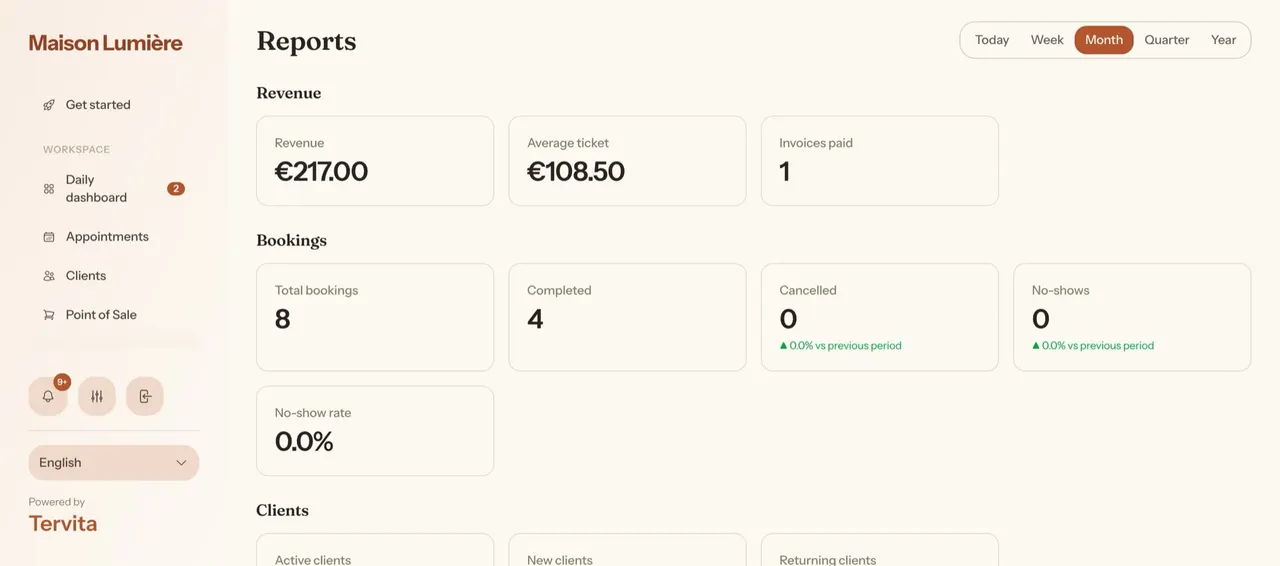
Tervita manages appointments, services, operational client records and reporting on booked activity and revenue. Consistent operational data can support a monthly reconciliation and help a business notice that turnover is approaching the VAT threshold. Our free salon booking systems guide covers the operational software choice, while the GDPR guide for salons and clinics explains separate client-data responsibilities.
Tervita does not choose your legal form, keep statutory books or file Form E, TSD, KMD or an annual report. It also cannot decide whether a contract is employment. Tervita separates operational records from statutory accounting; an accountant and, where needed, a lawyer assess the tax treatment and agreements.
Frequently asked questions
Can an OÜ owner take all company money as dividends?
Not where dividends would replace payment for the owner's active work. A dividend is a return on the shareholding. Serving clients, managing staff and running daily operations require a separate assessment of the correct remuneration and taxes.
Is an OÜ always more tax-efficient than an FIE?
No. An OÜ can retain profit before distribution, but owner remuneration, dividends, accounting and personal cash needs affect the total. An FIE's result depends on business profit, permitted deductions, other income and social-tax advances. Compare like with like rather than one headline rate.
Can an FIE deduct products, rent and training?
Documented expenses connected with the business can generally be deducted under the applicable rules. Personal and mixed-use spending must be separated. Ask about a specific course, trip or home-studio share instead of assuming that every receipt is allowable.
Is the VAT threshold different for an FIE and an OÜ?
No. Both use the €40,000 test for the relevant supply whose place of supply is Estonia, counted from the start of the calendar year. Separate rules can create obligations in some cross-border situations even before ordinary domestic turnover reaches that amount.
Does an OÜ invoice prove that a salon professional is not an employee?
No. Authorities and courts look at the real independence, management, control and allocation of business risk. The invoice and written agreement are evidence, but they cannot contradict how the parties actually work each day.
For a useful accountant meeting, prepare a one-page fact sheet: expected annual revenue, evidenced expenses, other employment, contractual commitments, monthly personal cash needs and the amount you hope to reinvest. That produces a far better FIE-versus-OÜ comparison than a promise that one form is always “cheapest.”