Salon loyalty program: how do you design one that the numbers can support?
Short answer: a good salon loyalty program gives clients a simple, predictable reason to return, but it cannot guarantee higher revenue. Choose one measurable behaviour, calculate the face value you will issue, publish concise rules and pilot the programme with a defined group. Loyalty membership and consent to promotional email or SMS are separate choices: creating a points account does not by itself give a salon permission to send marketing.
This is an owner-focused guide for a salon, studio or independent professional planning a retention programme. It is not a revenue forecast, accounting policy or individual legal advice. The legal sources and Tervita product boundaries below were checked on 13 July 2026.
What job should a salon loyalty programme do?
“Improve loyalty” is not a testable goal. Pick one behaviour: the share of first-time clients who complete a second visit within 90 days, the share who rebook a maintenance service within its normal interval, or the number of completed visits from an existing-client cohort. Launching points, birthday offers, referrals and a broad discount simultaneously makes it impossible to tell which change mattered.
Record a baseline before launch. For example, group everyone whose first appointment was completed in one month and measure how many returned within your chosen window. Apply the same definition after the pilot. A change still does not prove causation: seasonality, pricing, staff availability, advertising and service quality can all move retention.
Rewards cannot repair a difficult booking journey, long waits or inconsistent treatment. If clients struggle to choose a slot or forget appointments, work through the online booking guide and the guide to reducing no-shows first. A loyalty layer should support a reliable experience, not distract from a broken one.
Which salon loyalty model should you choose?
A small business can start with one of four understandable models.
- Spend-based points. A client earns points on eligible spend and redeems them later at a published value. The model is straightforward when sales consistently pass through one point of sale.
- Visit-based tiers. A status or perk unlocks after a defined number of completed visits. It can suit recurring services with broadly similar prices.
- Spend-based tiers. Status depends on eligible spend over a stated window. This distinguishes frequency from value but needs especially clear terms.
- A simple visit card. A paper or digital stamp card may be enough for one professional. It is easy to explain, although it becomes harder to reconcile across several team members.
Complexity is not a benefit by itself. A client should be able to say in one sentence how value is earned and used. A receptionist should see the same answer at checkout. If either person needs a private spreadsheet to interpret the reward, simplify the programme.
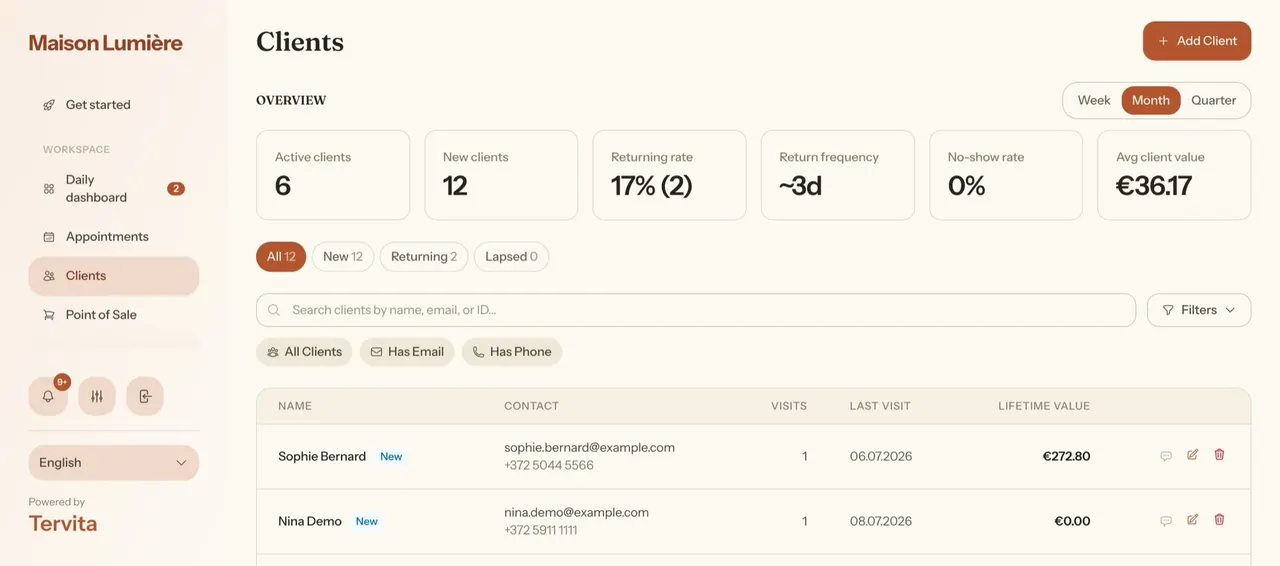
Tervita's currently verified loyalty workflow lets an owner configure points earned per €1 and the euro redemption value of one point. Eligible POS spend can award points automatically, and an authorised staff member can also award or redeem points on the client's ledger. Manual redemption reduces that balance and returns a euro-value reference; it does not automatically add a discount or payment line to the sale or link the ledger entry to that sale. The client account shows its balance, lifetime earned points and lifetime redeemed points. Tiers based on spend or visits are a separate POS mechanism; a tier reward can be a percentage discount, a free service or a custom written perk.
That description is not a promise of built-in referral tracking, automated marketing journeys, birthday campaigns, points expiry or a customer self-service loyalty app. Do not assume those workflows without a separate current check. When comparing products, use the salon software buyer's checklist and test each candidate against the rules you actually intend to publish.
How do you calculate a loyalty-points budget?
Separate three planning values:
Eligible sales = completed eligible visits × average eligible ticket.
Issued face value = eligible sales × reward rate.
Planning estimate of redeemed value = issued face value × the redemption share entered by the user.
Tervita stores two settings rather than one direct percentage: points earned per €1 of eligible net spend and the euro redemption value of one point. Convert them into an approximate nominal reward rate with points per € × € per point × 100%. Actual POS accrual rounds net spend × points per € down to whole points, so small tickets can produce a slightly lower effective rate. To model current Tervita in this calculator, enter the average eligible ticket on the same net basis.
Suppose 120 eligible visits have an average eligible ticket of €45. Eligible sales are €5,400. At a 5% reward rate, the programme issues €270 of points face value. If you enter a 70% redemption share as your planning assumption, the simple estimate is €189 of redeemed face value per month.
Monthly loyalty-points budget
Enter completed eligible visits and your assumptions; use a net ticket when modelling Tervita.
- Eligible sales
- €5,400.00
- in this monthly scenario
- Issued points face value
- €270.00
- in this monthly scenario
- Planning estimate of redeemed value
- €189.00
- in this monthly scenario
This is a planning calculation, not a revenue forecast or an accounting liability. You enter the redemption share; the actual effect depends on service cost, margin, rules, tax treatment and client behaviour.
The calculator's €189 is not automatically lost revenue or an expense. A complimentary add-on may have a variable cost far below its menu price, yet it still occupies staff time. A redemption may fill otherwise empty capacity or displace a full-price booking. Some points are used in a later month and some may never be used. Ask an accountant how your actual terms affect bookkeeping, tax and any obligation; this calculator does not decide those questions.
Create a separate eligibility table. State which services, retail items, packages and payment methods earn points, whether discounted sales earn the full rate, and what happens after a refund or corrected payment. Without those decisions, a precise-looking reward percentage does not create a reliable budget.
What rules should clients see before joining?
Publish one version that clients and staff can both find. It should cover:
- who can join, how enrolment works and how a member leaves;
- which completed purchases or visits earn value and when it appears;
- the earn rate and the redemption value of a point;
- excluded services, products, packages, gift cards or promotions;
- whether points can be combined with another discount;
- refunds, corrected payments, cancellations and no-shows;
- any expiry of points or tier status and how changes are communicated;
- how the salon may amend or end the programme and where a client can question a balance.
Do not leave important exceptions as oral instructions at reception. Before redemption, show the number of points and their euro value. Test POS accrual, a manual partial redemption, insufficient balance, correction of an accidental ledger entry and the tier reward separately. For a redemption or refund, staff must reconcile the points ledger with the sale or refund workflow themselves because the current product does not create an automatic link. Set separate staff permissions for viewing, configuring, earning and redeeming where the system supports them.
If you use tiers, make the measurement window visible. “Ten visits in twelve months” is different from “ten visits ever.” Explain what happens when a client falls below a threshold and whether a manual recalculation can change the current tier. A tier name is branding; the threshold and reward are the enforceable operational detail.
Does joining a loyalty programme mean consenting to marketing?
No. Processing data to operate a points account and using contact details for advertising are separate purposes. A salon must identify and document an appropriate lawful basis for each processing activity. The European Data Protection Board's small-business guide to lawful processing explains that, where consent is the chosen basis, it must be freely given, specific, informed and unambiguous, and withdrawal must be easy. Separate purposes need granular choices.
In practice, distinguish “Join the loyalty programme” from an optional “Send me offers by email/SMS” control. Do not pre-tick the marketing option. Declining promotion should not automatically erase service records or remove points already earned under valid programme rules. Leaving the programme and withdrawing marketing consent are different actions; describe the consequences of each.
The Estonian Data Protection Inspectorate's direct-marketing guidance says consent for electronic direct marketing to an individual must be demonstrable and the person must be able to object easily and without charge. The existing-customer exception for the sender's own similar services has conditions, including an opportunity to object when details are collected and in each message. The same framework appears in Article 13 of the EU ePrivacy Directive. A phone number collected to confirm an appointment is not automatically a general marketing permission.
Collect only what the programme needs. A conventional points account rarely requires date of birth, gender or sensitive treatment notes. A medical or aesthetics clinic should not segment promotions using health data without a separate legal assessment. Our GDPR guide for salons and clinics provides a broader worksheet for lawful basis, transparency, retention and client rights.
How should a salon measure retention without promising growth?
Measure repeat visits by cohort: what share of clients from a defined starting period completed another visit within a fixed window? For programme economics, track eligible sales, issued face value, redeemed face value, redemption share and the outstanding points balance. Add contribution margin on redemption transactions, while keeping menu price distinct from actual service cost.
Comparing members with non-members is often misleading because already-loyal clients may be more likely to enrol. Compare a cohort with its earlier behaviour or use a reasonably matched control period. Annotate price changes, staff leave, advertising campaigns and major changes in booking availability.
Review an initial pilot after four to eight weeks, but do not rewrite terms after every fluctuation. If redeemed value is above the budget, adjust future earning or eligible sales only through the published change process and with appropriate notice. If almost nobody redeems, first check whether clients can see or obtain their balance and whether staff consistently explain redemption.
A four-week launch plan
During week one, choose the target behaviour, cohort and baseline. In week two, agree the earning rate, redemption value, exclusions, refund treatment and budget with the relevant operational and accounting owners. In week three, publish terms, configure staff permissions, separate membership from marketing choice and run test transactions. In week four, enrol a limited group and record every client and staff question.
Avoid changing pricing, reminder policy and loyalty mechanics at the same moment if measurement matters. At the first review, consider errors and administration time alongside repeat visits and redeemed value. A programme is sustainable only when the team can operate the published promise accurately.
Frequently asked questions
What reward percentage should a salon offer?
There is no universal percentage. Start with service margin, normal repeat interval and your own redemption-share assumption. The calculator's 5% is an example, not a recommendation. A material-intensive service may need a lower rate or a specific tier perk instead.
Will loyalty points definitely increase repeat visits?
No. Points can make a reason to return visible, but service outcome, trust, availability and price still matter. Evaluate comparable cohorts and report uncertainty rather than attributing every change to the programme.
Should a client lose points after unsubscribing from email?
Not automatically. Withdrawing marketing consent is not the same as leaving the loyalty programme. Points and service records follow their own published terms and lawful bases; explain both choices before enrolment.
When is a salon ready to launch a loyalty programme?
When sales are recorded consistently, staff share one interpretation of the rules, clients can understand the calculation and the owner can measure issued and redeemed value. Without those controls, even a generous reward becomes a checkout dispute.