Short answer: Tervita has a compact price for teams of up to three and focuses on the salon's direct booking channel, multilingual web flow and internal controls. Timma provides a longer trial, native mobile applications and optional Ilukaart visibility. Both cover calendars, online booking and client management; the right choice depends on team structure and channel strategy.
What did this comparison verify?
Timma's public pricing page showed €17 per user per month plus 24% VAT on 21 July 2026. Selecting two users changed the price to €34 and three users to €51. The included list named a calendar, gift cards, online booking, email reminders, iOS and Android applications, reports, inventory tracking, customer support, user permissions, a GDPR-compliant solution, client records and email marketing. Timma advertised a free one-month trial without a credit card.
Tervita's public structure is one plan: €11 per bookable specialist per month, capped at €88 per month once a salon has eight or more, with every feature and location included. VAT is additional. Tervita's trial lasts 14 days without a payment card. A billable seat means a bookable calendar; reception or an administrator does not become another paid practitioner merely by signing in.
This comparison uses public Timma information and the operating Tervita product. It is not an audit of an authenticated Timma account. When a detailed limit or plan boundary is not available publicly, confirm it during a Timma demonstration. Apply the same standard to Tervita: a roadmap item or integration menu is not equivalent to a working external connection.
How does team size change the price?
For one specialist, the base prices are close: Tervita at €11 and Timma at €17 per month. With three bookable workers, Tervita reaches €33 while Timma's published per-user structure produces €51. The gap widens for a larger team only up to a point: Tervita's price stops climbing at €88 per month once a salon reaches eight bookable specialists, while Timma's public per-user structure has no published cap. Every Tervita figure already includes rooms, multiple locations, POS, inventory, packages and fuller reporting — there is no higher tier to compare against, so weigh the full Tervita price against whatever Timma plan actually carries the features the salon needs.
Timma's public add-ons included a website at €10 per month, a custom domain at €20 per year, individual SMS at €0.08 and a Timma Pay terminal at €19 per month plus transaction charges. Tervita includes email notifications in its per-specialist price and bills SMS separately: EUR 0.09 excluding VAT per carrier part, so a one-part SMS is EUR 0.09 and a two-part SMS is EUR 0.18. Tervita does not provide a website builder or a rented card-terminal package.
Build a calculation from real roles. Count revenue-producing calendars, administrative users, locations, monthly messages and required add-ons. The free versus paid booking system calculator also helps account for marketplace commissions and acquisition cost rather than comparing subscription headlines alone.
Does the salon need a marketplace or a direct channel?
Timma's meaningful distinction is the consumer-facing Ilukaart. Its pricing page lists visibility as optional and Timma's marketing positions it as an acquisition channel. For a salon that wants to appear in front of consumers already browsing a marketplace, that can be useful. Ask for current terms, measure genuinely new clients from Ilukaart and separate first appointments from returning clients.
Tervita does not operate a consumer marketplace. A studio shares its booking link, adds it to social profiles or embeds it into its website. That keeps a direct path beside the salon brand but does not create demand automatically. When discovery is the primary need, the Timma model is functionally closer. When the salon already has followers, local search or advertising and wants traffic in its own process, Tervita may fit better.
“No commission” does not mean “no marketing cost.” A direct channel still needs a website, social account, Google profile or another source of traffic. A marketplace can have its own pricing, competition and client expectations. This is a channel decision rather than a moral judgement.
Is a native mobile application necessary?
Timma's public pricing includes iOS and Android applications. That is a concrete advantage for a team requiring a native icon, operating-system notifications or App Store installation. Exact offline behaviour and feature parity need confirmation in a demo, but the existence of the applications is publicly stated.
Tervita is a responsive web application. It works in phone, tablet and desktop browsers and can be added to a home screen, but it is not a native iOS or Android application. The web model keeps one version updated and requires no installation for client booking. If a native app is a procurement requirement, Tervita should not disguise its absence as “effectively the same.”
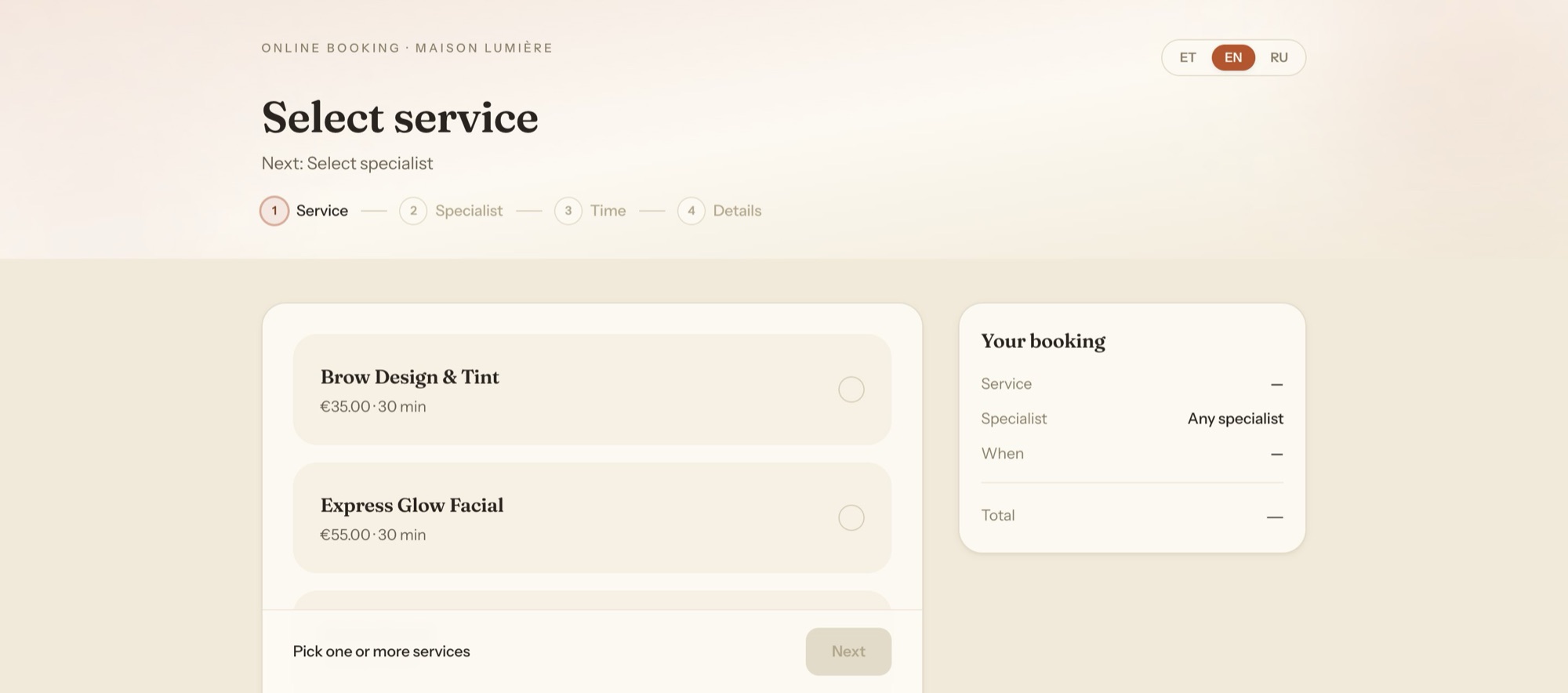
On the client side, test the specific flow rather than assuming app requirements. Open the public link on a real phone, choose a service, switch language, inspect the confirmation and try an allowed cancellation. The salon software buyer's guide provides the same demonstration checklist for both products.
How do security and administration compare?
Tervita includes MFA, role-based access, custom roles, audit history and GDPR tools on the single plan. The principle is that client-data protection should not become an upsell only after an incident. Consent is distinct in the client workflow, while server-side permissions remain a separate protection layer from visible UI controls.
Timma's public pricing lists user permissions and a GDPR-compliant solution. It would be unfair to infer detailed MFA, audit event or permission granularity from that short list. Ask during a demo whether MFA is optional or enforceable, whether an activity log can be exported, which roles can view revenue and how data-subject requests are handled.
When should a salon choose Timma or Tervita?
Timma is a logical candidate when the salon values a one-month trial, native mobile apps, Ilukaart exposure, a website add-on or the Timma Pay terminal ecosystem. It is a more mature Nordic product with a broad public feature list. The salon should still calculate per-user pricing with its actual team.
Tervita is a logical candidate when simple per-specialist pricing capped at €88 per month, free and unlimited non-bookable admin users, a direct multilingual channel, MFA and audit controls, and an Estonia-focused small-business workflow matter more than a native app or marketplace. Tervita is the younger product. That maturity difference should not be hidden; use the trial to complete a real booking, invoice, cancellation and reporting check.
Do not decide from this table alone. Configure the same five services and three roles in both products. Book from a phone, move the appointment, send a reminder, record a payment and export the view you need. Count the steps staff still repeat by hand. The better system is the one whose boundaries fit the business and whose workflow the team will actually use.