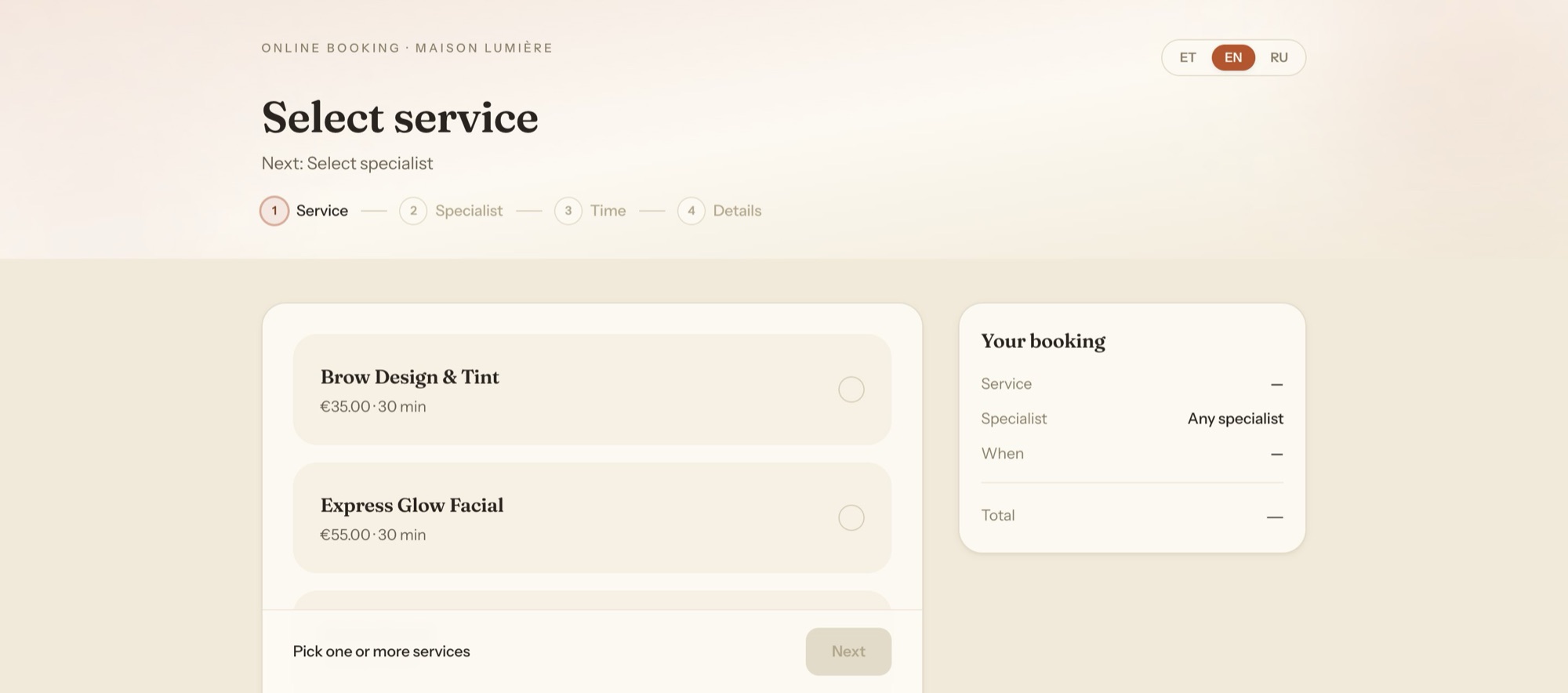
Short answer: lash and brow booking software must distinguish services that take twenty minutes from services that take several hours. When full sets, refills, removals and lifts reserve accurate durations with eligible artists, the day remains realistic. Tervita adds the studio's own booking link, client records, reminders and sales tools around that schedule.
Why does the service name affect the whole day?
A lash-and-brow calendar is not a sequence of equal blocks. A new full set may take hours, a refill depends on the existing work, removal is shorter and a brow tint or shape needs another interval. If a client can only choose “lashes,” the artist has to clarify before every visit or discovers an insufficient interval when the client arrives.
Each variant is a separate service in Tervita. It has a client-friendly name, description, duration, price, eligible artists and a public-booking state. A studio can organise services into lash, brow and combination categories. The category helps discovery and the description helps a decision. A very long catalogue is not an advantage when the client cannot understand the difference.
An artist does not have to provide every service. A new employee may offer classic sets, another volume and a third brows only. Online booking lists the specialists assigned to the selected service. Working hours, leave, an extra shift and a date-specific exception all change the available times.
How does the studio publish its booking link?
The studio receives a public link for an Instagram bio, Google business profile, message or advert. A client opens it on a phone, chooses a service, artist and time, then supplies contact details. They do not install a Tervita client application. An existing site can use an inline, popup or bubble widget; the website booking guide provides the supported implementation options.
The studio decides whether a service price is visible. Duration, category and service wording still need to be honest. When the final amount depends on the work required, the description can explain a starting price or consultation, but the system cannot inspect lash condition or calculate material cost automatically.
Estonian studios often serve clients in several languages. The public Tervita flow supports Estonian, Russian and English along with other product locales. The studio adds translated service names and descriptions because an English fallback in the middle of a Russian booking flow is not a polished experience. A language choice changes the client view, not the underlying calendar appointment.
How do you reduce empty gaps without aggressive marketing?
The first step is a clear confirmation. A client should immediately understand whether an appointment is confirmed or waiting for approval. The second is a reminder early enough for the client to react. The third is a usable management link and a cancellation rule shown before a problem. A penalty revealed only after a missed visit is not a complete workflow.
Email works for a detailed confirmation; SMS can carry a short time-sensitive reminder. SMS is metered usage and should be budgeted from booking volume. Tervita does not claim that one message eliminates no-shows. The practical no-show guide helps studios choose timing and policy without an invented performance guarantee.
Before adding waitlists or last-minute campaigns, a studio can make open times visible through its direct link. If promotional messaging is activated later, marketing consent remains separate from loyalty membership and service communication. An appointment confirmation does not grant permanent permission for unrelated sales messages.
What belongs in the client record?
The client record can combine contact details, visits, consent, invoices, packages and notes needed for service. An artist may need the previous service variation or a confirmed preference. A note should remain factual and understandable if another authorised colleague reads it.
Photos, allergies and health-related details may be sensitive. They are not collected merely because a document or notes field exists. The studio determines purpose, lawful basis, access and retention. Roles restrict access to client or sales information, MFA protects accounts and audit history helps investigate changes. Those controls do not replace a studio policy on what should be written in the first place.
When clients come from another platform or a phone list, begin with active records and duplicates. Tervita does not promise an automatic Timma or Fresha migration until a particular export format and reconciled import workflow exist. For a small studio, deliberately moving future appointments and active clients is often safer than copying every historical record without review.
How do gift cards and loyalty fit the workflow?
Tervita can issue gift cards, sell packages and operate loyalty. A gift card has a code, value, status and remaining balance. A package attaches a fixed number of uses to a client. Loyalty can award points from eligible completed sales. These are three different products with separate rules; they should not appear to a client as one unclear “bonus balance.”
Loyalty economics need a budget. Generous points on a low-margin service may increase visits but reduce cash retained by the studio. The loyalty programme guide and calculator help estimate the cost. Software applies the chosen rule consistently; it does not decide which reward is profitable.
Inventory can cover retail products and consumables the studio chooses to track. Tervita does not promise automatic supplier ordering or exact consumption down to every lash fan. The purpose is an operational stock view, not a specialist beauty manufacturing ERP.
What does the studio pay?
Tervita is one plan at €11 per bookable artist per month, capped at €88 per month once a studio reaches eight artists. It is a strong starting point for an independent artist or a small studio needing online booking, calendars, client management, email notifications and invoices — and the same price already includes multiple locations, room or stock constraints, point of sale, packages, gift cards, loyalty, compensation inputs and fuller reporting. A reception account does not need to become a paid artist calendar; non-bookable staff are free and unlimited. Only SMS is billed separately, at cost — email is included.
How should you run the first test?
Enter five to ten real services with actual durations and eligible artists. Add ordinary working hours and at least one date-specific exception. Make a test booking with your own contact from phone and desktop. Check the service wording, language, time, confirmation, cancellation and calendar result. If a tester chooses the wrong service, improve the catalogue before publication.
Then add already agreed future appointments and choose the day the new link becomes the only public booking channel. During the first week, watch for wrong service selection and manually extended visits. Those cases reveal which description or duration needs adjustment. The studio page and workflow can then improve from real behaviour rather than an AI-expanded generic salon template.