How to price salon services: cost, capacity and margin
Short answer: Price a salon service from the bottom up. Add labour for the real appointment time, consumables, payment and commission costs, and a fair share of fixed overhead. Divide by the sellable share of capacity, then add the target operating margin and applicable VAT. Finally compare the result with demand and positioning; never let a competitor's menu replace your own calculation.
Pricing is not a one-time branding exercise. Rent changes, wages move, treatment time drifts and consumables become more expensive. A price can look profitable on a service list while losing money after cleanup, gaps and card fees are included. The solution is a repeatable worksheet and a dated review, not intuition alone.
What costs belong in a salon service price?
Separate costs into four buckets.
Direct labour includes service time, setup, cleanup and required documentation. Use the employer's real hourly cost or agreed contractor/commission rule, not only take-home pay. If a 60-minute treatment blocks 75 minutes, price 75.
Direct materials include products consumed, disposables, laundry and any device usage charged per treatment. Measure an ordinary service rather than assuming the full container is used evenly.
Transaction costs include payment processing, marketplace acquisition fees where applicable and staff commissions tied to the sale. A card-processing fee is not the same as a booking marketplace commission or software subscription.
Allocated overhead includes rent, utilities, insurance, software, cleaning, reception, training and non-billable management time. Choose a documented allocation method: per bookable hour, per room-hour or per service category.
The inventory guide helps turn product usage into reorder quantities rather than rough guesses. The staff-pay guide explains why salary, commission and chair rent create different cost structures.
How do you calculate the minimum sustainable price?
First calculate cost before profit and VAT:
service cost = direct labour + materials + transaction costs + allocated overhead
If the desired operating margin is 20%, do not merely add 20% to cost. Use:
net selling price = service cost ÷ (1 − target margin)
With a €48 cost and a 20% target margin, the net price is €60. Adding 20% would give €57.60 and only a 16.7% margin. Then apply the legally appropriate VAT treatment to reach the displayed consumer price.
Estonia's standard VAT rate has been 24% since 1 July 2025. Registration status, time of supply and possible exemptions still matter, so use the current Estonian Tax and Customs Board VAT guidance and your accountant. This article is a management model, not a tax ruling.
Build a service price from its cost
Enter one service's cost lines, target operating margin and applicable VAT rate.
- Service cost
- €48.00
- Net selling price
- €60.00
- Customer price
- €74.40
A planning calculation is not a tax or profitability statement. Verify the VAT treatment and replace estimates with measured costs.
Why does capacity change the answer?
Fixed overhead must be recovered from hours that can realistically be sold, not every hour on the clock. If a room is available for 160 hours but leave, cleaning, admin and normal demand leave 100 sellable hours, dividing rent by 160 understates the cost of each sold hour.
Use a conservative utilisation assumption based on your own history. Do not set the denominator to 100% occupancy; a business needs buffers, breaks and room for changes. For a shared device, calculate its bottleneck separately. A specialist may have time while the only laser is occupied.
Check the service duration in the calendar. Repeated overruns are a pricing signal and an operations signal. You may need a longer slot, a clearer scope or a separate add-on. Shortening the displayed duration without changing the real work only moves the cost into late starts and unpaid overtime.
Should you copy competitor prices?
Competitor menus tell you how clients may frame the choice, but not what your service costs. Compare like with like: treatment scope, practitioner experience, location, included products, consultation, cleanup, guarantee and tax-inclusive display. A €50 headline may exclude an add-on that your €65 service includes.
Choose a positioning you can explain. A higher price may be coherent with scarce expertise, longer consultation, premium materials or a more private setting. A lower price may work with shorter duration, off-peak capacity or a deliberately narrow scope. It is not coherent when funded by unmeasured unpaid labour.
How should discounts and packages be handled?
Every promotion needs a floor. Calculate margin after the discount, commission and payment fee. Limit the eligible time, service or audience if the objective is to fill otherwise empty capacity. Avoid permanent “temporary” discounts that train clients to wait.
For a prepaid bundle, calculate the effective price of every redeemed visit and the future capacity owed. The treatment-package guide covers validity, outstanding sessions and refund rules. A package can improve commitment, but cash received today is not permission to ignore delivery cost tomorrow.
When should salon prices be reviewed?
Set a quarterly review and event-based triggers:
- key material cost changes beyond a chosen percentage;
- wage or commission rule changes;
- VAT or registration changes;
- persistent appointment overruns;
- service utilisation becoming consistently too low or too high;
- a new device, room or qualification changing delivery cost;
- repeated manual discounts or refunds.
Do not automatically change every price each quarter. Recalculate, document the reason and decide. When prices do change, update the booking page, service descriptions, packages, gift cards, printed menus and staff scripts together. Give clients clear notice for already-booked visits and honour the terms you promised.
What can Tervita calculate for you?
Tervita stores service prices and durations, publishes them to online booking, records completed sales and shows operational revenue and service reports. The services and catalog guide covers the product setup, while reports show results by period.
Tervita does not currently promise margin accounting, automatic cost allocation or dynamic pricing. Keep the costing worksheet under owner or accountant control, then enter the approved price into the catalog. That is safer than presenting an attractive dashboard estimate as profit.
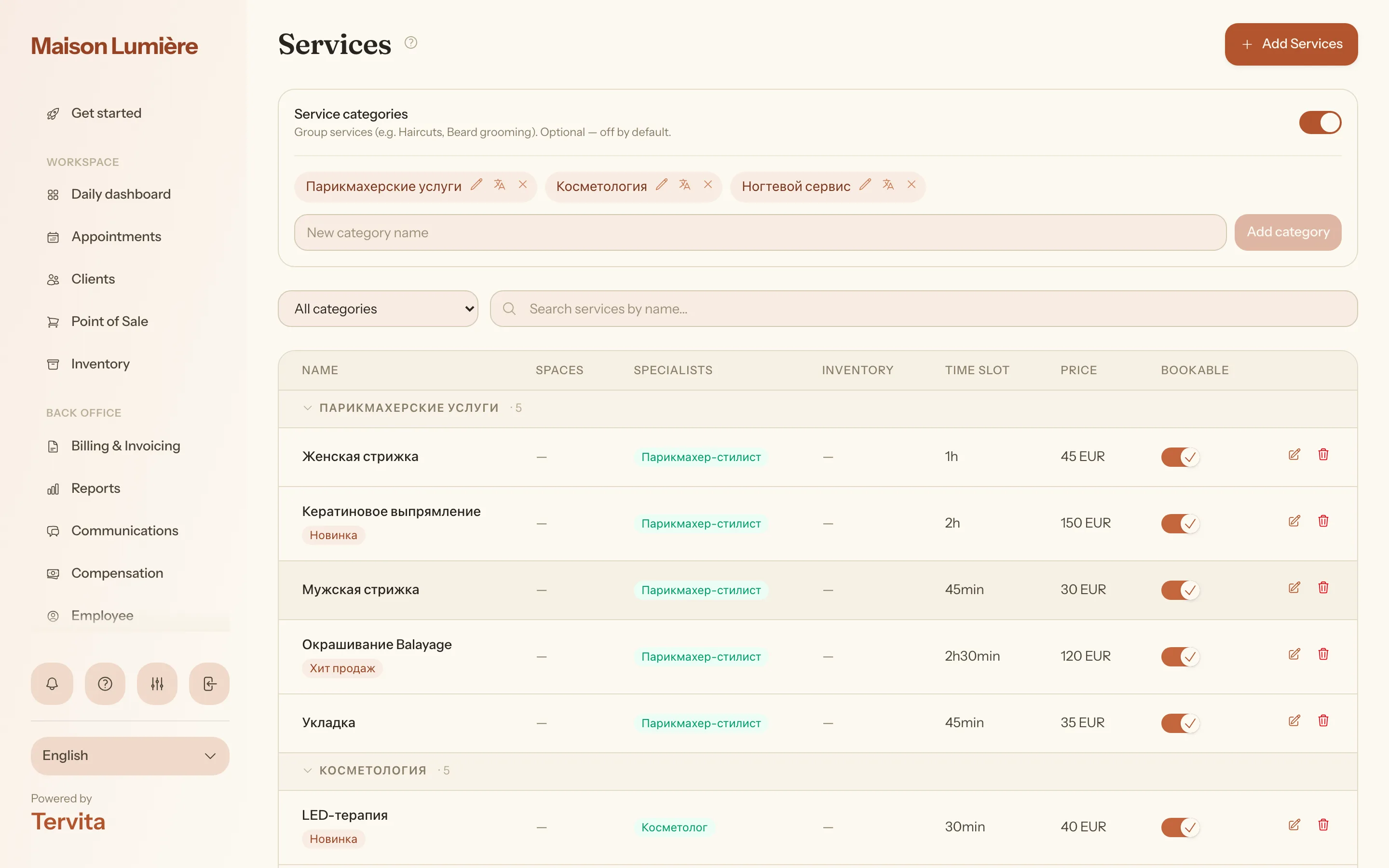
Start with the three services that generate the most revenue or consume the most capacity. Time one ordinary appointment, count materials, assign overhead and calculate the price at today's costs. The result may confirm the menu or expose a gap. Either outcome is useful because the next decision is based on evidence. Try Tervita for 14 days when you are ready to keep prices, durations, bookings and sales in one operating flow.