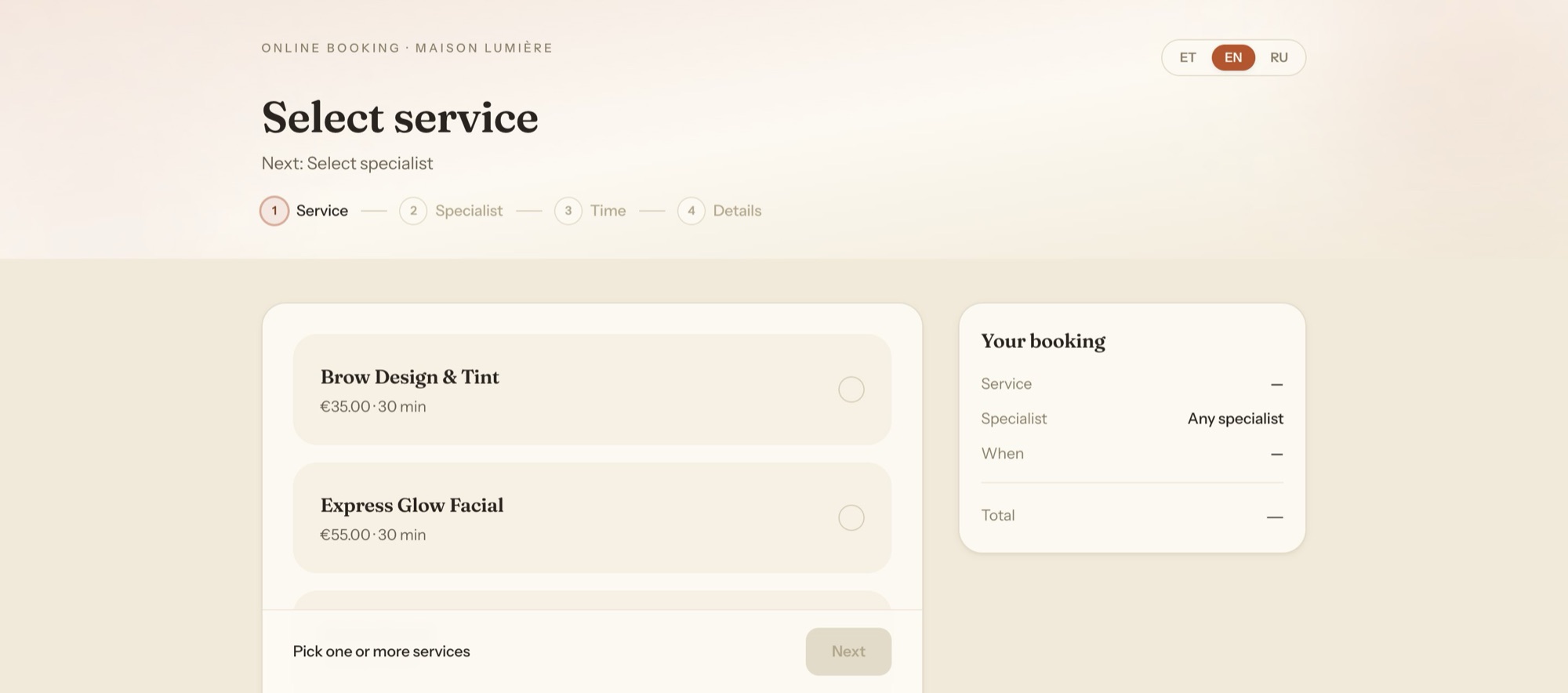
Short answer: massage business software should control the session length, practitioner schedule, room availability, client confirmation and repeat purchase at the same time. Tervita brings those parts into one web workflow, one plan and one price per bookable practitioner. An independent therapist can begin with a simple calendar, while a multi-room studio uses the same plan for room, package and inventory operations.
Why does a massage calendar need more than open squares?
Massage services are not interchangeable appointments. A menu may contain a thirty-minute targeted treatment, a sixty-minute classic massage and a ninety-minute combined session. The practitioner may also need time to reset the room, change linen or complete payment. If every service uses one default duration, the day becomes inaccurate as soon as the first client changes service.
Duration is a service property in Tervita. The service is also connected to eligible practitioners, a price and its public-booking state. The studio controls how far ahead clients may book and when last-minute booking closes. Date exceptions handle training, leave or an added shift without rewriting the ordinary weekly schedule.
Room availability is a second constraint in a larger studio. Two practitioners can be working while only one suitable treatment room is available. Tervita can associate a service with a room. Online availability can therefore represent a usable workplace rather than merely a free practitioner.
What does the client booking experience look like?
A client opens the studio link on a phone or computer, chooses a service, practitioner and available time, then provides the necessary contact details. No Tervita account or separate application is required. The studio can place the link in social profiles and its Google business listing or embed online booking into its website.
Service names should be understandable without internal abbreviations. Duration and price appear before selection when the studio chooses to show the price. Categories can separate relaxation, sports and facial services. Categories should make a decision easier, not turn the booking flow into a catalogue of nearly identical variants.
The appointment produces a confirmation. Reminder timing and channel belong to the studio configuration. Email works as the default; SMS can be useful for short, time-sensitive messages. The message should reflect a real appointment and a valid client contact. Tervita does not guarantee a specific reduction in missed visits, but the no-show workflow guide helps the studio remove avoidable confusion.
How do you keep client records useful and safe?
The client record can include contacts, visit history, consent, packages, gift cards, invoices and notes needed to provide the service. A practitioner may need to know the pressure preference or the service used last time. That does not justify storing every health detail mentioned in a conversation forever.
For sensitive information, ask three questions: is it genuinely needed for the service, who must see it and when will it be removed? A marketing segment must not be based on a health issue merely because somebody wrote it in a note. Joining a loyalty programme is not the same as marketing consent. Roles, permissions, MFA and audit history provide technical controls, but the studio still needs an operating policy.
Do not import an old client list blindly. Begin with active clients, merge duplicates and distinguish a verified fact, consent record and internal note. The client management guide describes a cleanup process without pretending that an inconsistent spreadsheet becomes reliable through one upload.
How do packages and gift cards work?
Repeat sales do not have to depend on a verbal promise to book again. A service package can contain a defined number of uses. After the sale, the package belongs to the client and each redemption reduces the balance. Staff can see remaining uses in the client or sales workflow rather than searching for a stamped card.
A gift card has a value, code, status and balance. The studio can issue it and later use it as a POS payment method. The system does not write validity, refund or transfer terms on behalf of the studio and does not automatically determine the VAT treatment of every voucher. Those decisions need documentation before sales begin. The salon gift card guide covers the questions to resolve before a campaign.
Loyalty can award points from eligible completed sales when a programme is active. Rules should stay simple: what earns points, where they may be used and what happens after a refund. Software makes the calculation consistent but does not guarantee retention or profitability.
What does a massage business pay?
An independent therapist or a studio with several bookable practitioners is on the same plan: €11 per bookable practitioner per month, capped at €88 per month once a studio reaches eight practitioners. It covers online booking, client management, email notifications and invoices across every location from the start. When the workflow does not need room constraints, point of sale or packages yet, there is nothing extra to pay for holding that option in reserve — it is already included.
The same price covers several locations, room assignment, product sales, packages, gift cards, loyalty, inventory and fuller reports once the studio needs them. A reception user does not become a paid massage practitioner merely because they manage the calendar — non-bookable staff are free and unlimited.
SMS is billed separately, at cost. This keeps the plan understandable and lets the studio decide which notifications deserve a text and which can use the included email channel. Estimate message cost from real monthly appointments instead of treating SMS as part of the subscription price.
How do you run a pilot without risking the client day?
Choose one service group, one or two practitioners and the real rooms. Enter accurate durations, working hours and turnaround needs. Make a test booking only with your own or team contact details, check mobile booking, confirmation, cancellation and the resulting calendar interval. Test a package or gift card in a controlled context if it is part of the intended workflow.
Once the core process works, add future appointments and publish the new link. Avoid leaving old and new public calendars active for a long parallel period; a client can otherwise book into two separate sources of truth. During the first week, record every manual correction: wrong duration, missing room, confusing service name or an impractical notice period. Those findings are more valuable than another item on a feature checklist.
Tervita is for a massage business that wants its brand, client relationship and operating data in its own workflow. It is not a massage marketplace and does not automatically create demand. It makes available time bookable, repeat products traceable and the daily plan consistent — provided that the studio configures its real rules instead of only uploading a logo.