Winning back lapsed salon clients
Short answer: decide first how many months of silence make a client lapsed — take the number from the service cycle, not from a feeling. Then check the legal basis: using a private individual's electronic contact details for direct marketing needs their consent, unless the contact came from serving them, you are offering a similar service, and every message carries a clear way to opt out. Only then write — short, personal, no manufactured urgency. Health notes must never define a segment.
A client who has already been to you is the cheapest growth a salon has. They know the place, they know the specialist, and you have their contact details; finding a new client costs several times more. It is also where a salon most easily breaks the law or its own reputation: a bulk "we haven't seen you in a while" to the wrong list is both annoying and a complaint waiting to happen.
After how long is a client actually lapsed?
There is no single correct number, because it depends on the cycle of the service. A sensible starting point is that client's usual interval multiplied by one and a half.
- A cut or colour refresh on a 6–8 week cycle: lapsed at roughly 3 months.
- Nails on a 3–4 week cycle: lapsed at 8–10 weeks.
- Facials on a 2–3 month cycle: lapsed at 5–6 months.
Check those numbers against your own data. If most of your clients come back in the fourth month, a message in the third simply interrupts someone who was going to book anyway.
Three situations are worth separating, because they deserve different messages: the client who came once and vanished; the regular who went quiet; and the client who told you they are not coming back. The last one belongs on no list at all.
What may you legally send to a lapsed client?
This is where practice and law part company more often than salons realise. Under § 103¹ of the Estonian Electronic Communications Act, a private individual's electronic contact details may be used for direct marketing with their prior consent. The exception covers your existing clients: if you obtained the contact while providing them a service, you may market a similar service, provided the person was given a clear and comprehensible way to refuse both when the contact was collected and in every message that follows. The Data Protection Inspectorate sets out the conditions in its guidance on using electronic contact details for direct marketing.
Three rules follow, worth writing down before anyone sends anything.
- A booking is not marketing consent. That someone visited you does not mean they want offers. The exception allows a similar service and demands an opt-out — it is not a free hand.
- A reminder is not a campaign. Confirmations and reminders are part of delivering the service. "20% off this week" is marketing. The two must not travel under one heading.
- An opt-out is immediate and permanent. Once someone says no, they leave the list and do not reappear for the next campaign.
Is this win-back list ready to send?
Work through these before the first message. Ticks are not saved once the page is closed.
Why must sensitive notes stay out of segments?
A salon record — and a clinic record especially — often holds health information: allergies, skin condition, medication, pregnancy, contraindications. Under the GDPR that is special category data, and using it for marketing is a separate and far stricter matter.
In practice the line is simple. "Clients whose last service was a cut and who have not visited in four months" is an ordinary business segment. "Clients whose record mentions hair loss" is not a segment to send an offer to, even when the offer would genuinely help them. The same holds for pregnancy notes, skin conditions and medication.
If an offer really would help a particular person, make it in conversation or as an individual message, not from a list. The lawful bases and client rights are set out in the GDPR guide for salons and clinics, and the record-keeping side in the client base guide.
Which message actually brings someone back?
Short, personal and free of pressure wins. Three things usually make the difference:
- Name the last service. "Your last colour was in April" proves the message comes from the salon they actually visited, not from a random sender.
- Make the next step one tap. A link to the booking page is the point of the message; without it a good intention stalls.
- Do not invent urgency. "Today only!" works once and costs trust. A calm "come back, there is time available" lasts longer.
A discount is optional. For many clients the reminder itself is enough, and a discount simply reduces revenue from people who would have booked anyway. If you do use one, tie it to the service you need to fill and to a narrow window.
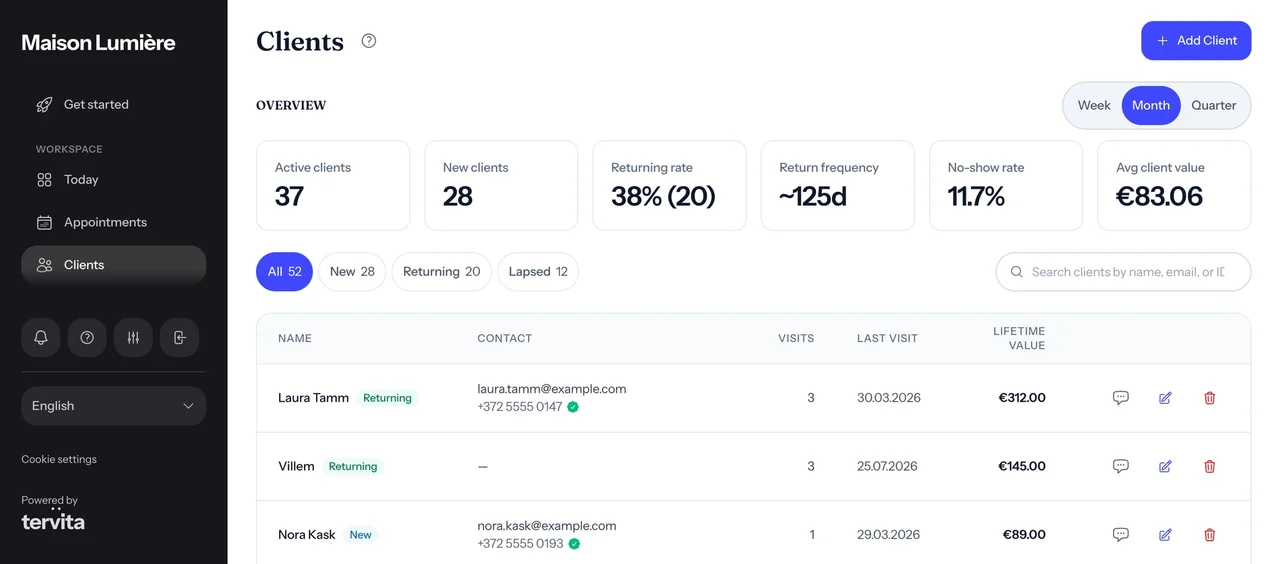
What Tervita does here today — and what it does not
Honesty matters more than a sales line. Tervita holds client records with visit history, contact details, a marketing-consent flag and an opt-out list that shows who must not be contacted. The consent model is described in the client records and consents guide, and the booking page controls in the booking settings guide.
What Tervita does not do today: there is no campaign sender that will message a list for you, and no automatic lapsed-client workflow. What goes out automatically is appointment-related — confirmations and reminders — which is not marketing. A win-back campaign is manual work today: the list, the wording and the sending are your decision and your responsibility.
That boundary is deliberate. If you later run campaigns through another tool, the same rules apply: consent or the existing-client exception, an opt-out in every message, and segments that are not built on health data.
How to make this a calm monthly habit
Treat it as a small monthly routine rather than a big campaign. Once a month, look at the clients whose last visit has crossed your threshold, remove anyone who opted out or already holds a future booking, and send the rest a short note. Record how many came back. Three months of that will tell you whether your threshold is right and whether the wording works.
And do not forget the other half of the problem: the cheapest way not to lose a client is to book the next appointment while they are still standing at the desk. That, and the rest of the empty-chair problem, is covered in the guide to reducing no-shows.